|
|
|
|
|
|
|
|
|
|
|
|
|
|
|
|
|
|
|
|
|
|
|
|
|
Tips and Tricks |
|
|
|
|
|
|
|
|
This page contains practical tips that I've learned over years of piñata-making. You'll also find more information on the Instructions page, along with links to illustrated step-by-step examples of how I made some of the piñatas on this web site. |
|
|
|
|
|
|
|
|
|
|
|
|
|
|
|
|
|
|
|
|
|
|
|
|
|
|
Before you start:
Don't sweat the mistakes. All of my piñatas have mistakes. The papier mâché part is never perfect, but the decorating step hides the bumps and scars well, especially if you cover them with fluffed crepe paper. (That's why it's my favorite technique!) Once your piñata is decorated, nobody will notice the mistakes. |
|
|
|
|
Working with balloons: Use balloons to form the body of the piñata. I occasionally use thin cardboard or posterboard for a non-target part of a piñata, such as the nose of the Rainbow Zebra, but even the thinnest cardboard is almost impossible for kids to break. If you must use cardboard or posterboard for a target area, make sure you weaken it by punching lots of holes in it with scissors or a knife. |
|
 |
|
|
|
 |
|
Wrap the balloons in newspaper before putting down papier mâché. If you lay the papier mâché newspaper strips directly onto the balloon, it takes more layers of papier mâché before the piñata will hold its shape. You're also more likely to have your balloon pop, especially if you let it dry in the sun. Instead, wrap the balloon in newspaper and use masking tape to hold it in place. Try to wrap reasonably smoothly -- you can cut off excess newspaper if you need to. You'll never get a perfectly smooth wrapping, but the first wet layer of papier mâché will help smooth out the bumps. But if you do a really sloppy job of wrapping, you will end up with a bumpy piñata. |
|
|
|
|
|
|
|
|
|
|
|
|
|
|
|
|
|
|
|
|
|
|
|
|
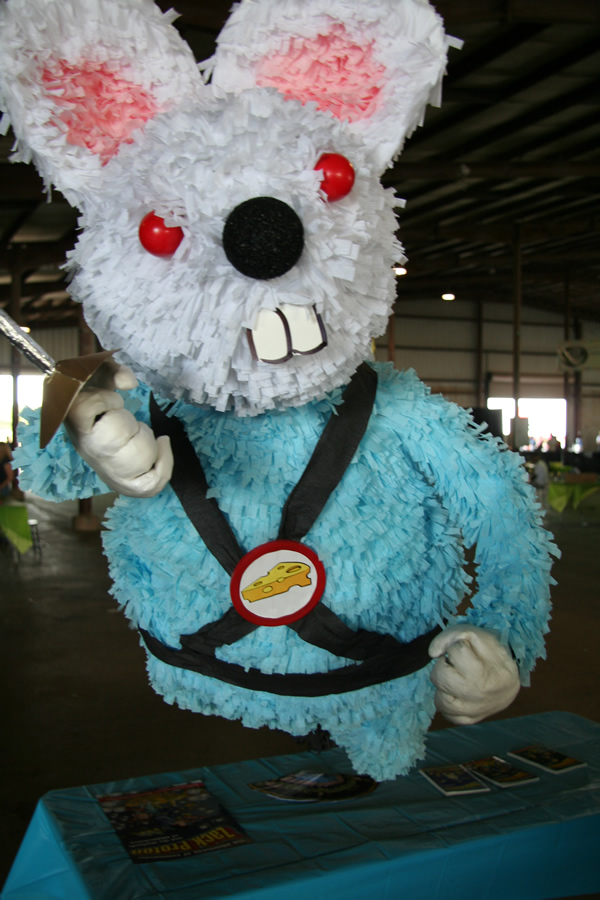
Use different sizes and shapes of balloons. Those long, thin balloons for making balloon animals are really versatile. I used them for making the ghost's arms and the bat's wings, as well as for arms and legs on the Warlord of Nibblecheese, snakes in Medusa's hair, and so on. Blowing those up gives me a headache, so I bought one of those hand-held plastic balloon pumps. A bicycle pump also works. |
|
 |
|
| |
To shape long balloons, wrap them in a spiral of newspaper strips instead of a whole sheet. If you wrap a long balloon in a whole sheet of newspaper, the balloon will fold instead of curve. Bend the balloon into shape and tape it to itself. Apply papier mâché, and once the balloon holds its shape, cut the masking tape away. |
|
| |
|
 |
 |
|
|
|
|
|
|
Choose the right punch ball for making large piñatas. There are two different kinds of balloons that are both labeled "punch ball." They look almost identical before they are blown up, but are very different when inflated. The ones with a lip on the valve (like a regular balloon) blow up larger but not quite round. The ones with a straight pipe opening blow up smaller, but almost perfectly spherical. |
|
|
 |
 |
|
|
|
The larger punch ball was used for Hello Kitty's head, the Pirates of the Caribbean piñata, and the head and body of the Shoyru and Feepit piñatas. I used two of these in the body of the Rainbow Zebra. The smaller, spherical punch ball was used for the Planet piñata, the head of the Princess Duckie, the Vampire Smiley, and the Christmas Smiley (picture coming soon). |
|
|
|
|
|
|
|
|
|
|
|
|
|
|
|
|
|
|
|
|
|
|
|
|
Working with papier mâché:
It's messy! When I do this in my kitchen there are always drops of papier mâché paste all over the place. I usually do this part in my back yard. Use about a 1:1 ratio of water and flour. For example, combine one cup of water with one cup of flour, then mix with a whisk. It will end up the consistency of pancake batter. If you use thicker paste (more flour than water), it makes a harder layer. If you use thinner paste, the layer ends up being weaker. I usually just go safely down the middle at one to one. |
|
|
 |
|
 |
|
Use a wide bowl for the paste. It's easier to work in a bowl with outward sloping sides than in a bowl with vertical sides. |
|
|
¡bueno! |
|
not so bueno... |
|
|
|
|
|
|
|
|
|
|
|
|
|
|
|
|
|
|
|
|
|
|
|
|
|
|
|
|
|
|
|
|
|
|
|
|
|
|
|
 |
|
Use different width strips of newspaper for the papier mâché. Don't just tear all your strips the same width. Use wider strips to cover large areas faster, and use smaller strips when working in smaller areas. I don't actually tear my newspaper strips -- I use a paper cutter instead to get nice, straight edges, but I'm kind of neurotic that way. |
|
|
|
|
|
|
|
|
|
|
|
|
|
|
|
|
|
|
|
|
|
Make a strong hanging point! The hook will have to support the entire weight of the (filled!) piñata, and if you do it wrong, your piñata will crash embarrassingly to the ground. This part is so important I made a special Hook Page. |
|
|
|
|
|
|
|
|
|
|
|
|
|
|
|
|
|
|
|
|
|
|
|
|
|
|
|
|
|
|
|
 |
|
|
|
|
|
|
|
The balloon will try to roll when you apply wet strips of newspaper. I put the balloon in a bowl to keep it still.
To dry the wet papier mâché faster, set up a small fan blowing on it. Even in 100 degree heat, a wet papier mâché balloon dries a lot faster with a fan blowing on it. |
|
|
|
|
|
|
|
|
|
|
|
|
|
|
|
|
|
|
|
|
|
|
|
|
|
|
|
|
|
|
|
|
|
|
|
|
|
|
|
|
|
|
|
|
|
|
|
|
|
 |
|
Weaken tough piñatas. With larger piñatas especially, you have to make them a certain minimum thickness just to support their own weight, and then they're too tough for the kids to break. If your piñata walls feel too hard, take a knife and stab the piñata repeatedly to weaken them. I have had to do that will all my large piñatas. This photo is from the Make a Zebra page. The red circled mark is one gash, but all of the short black lines are also knife stab holes. I added more after taking this picture. |
|
|
|
|
|
|
|
|
|
|
|
|
|
|
|
|
|
|
|
|
|
|
|
|
Decorating your piñata:
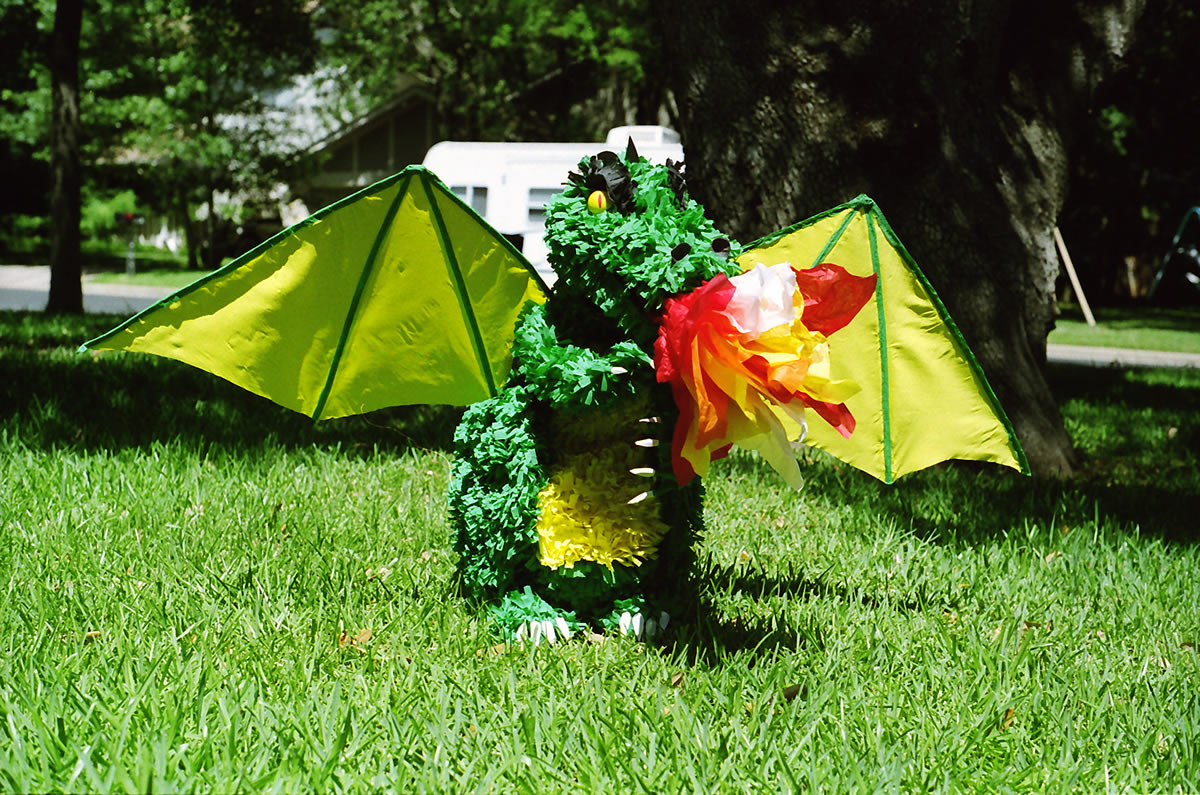
There are many different ways you can decorate a piñata. I use crepe paper whenever possible because it's festive and colorful and does a great job of hiding the flaws underneath. There is so much to say about crepe paper that I made a separate crepe paper page. But there are many other ways to decorate a piñata. The photo from the home page shows five different methods. Since these piñatas were made at the same time for a Maker Faire in Austin, I wanted to show a variety of techniques. |
|
|
 |
|
|
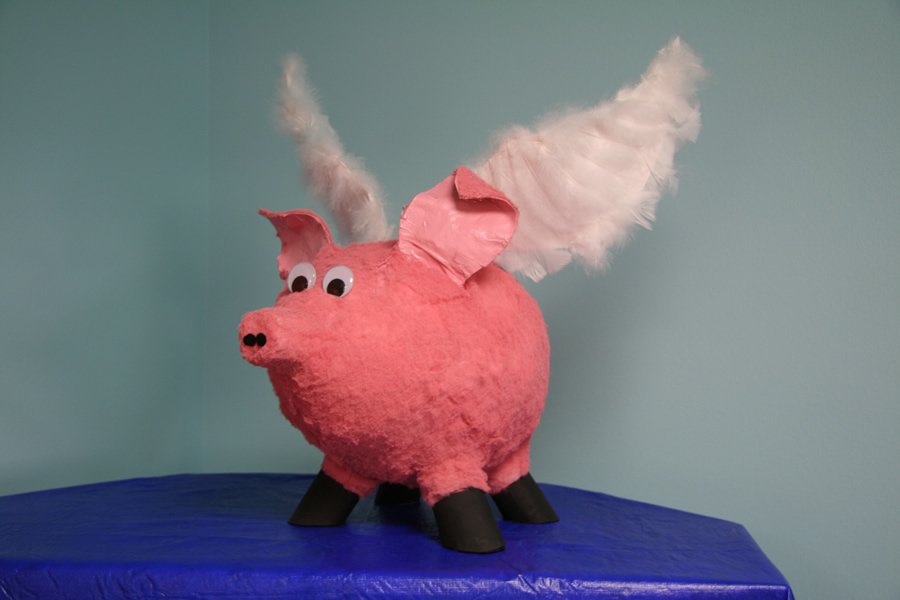
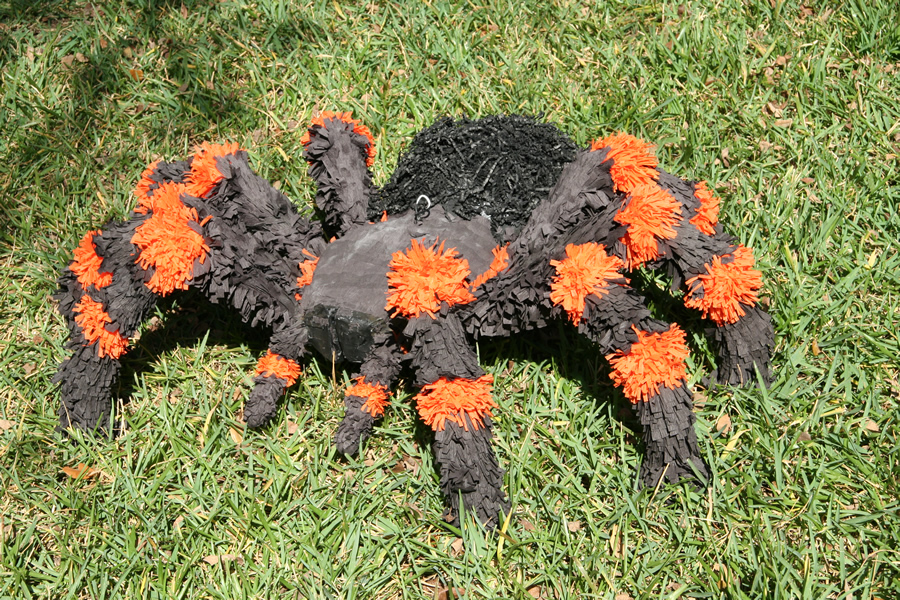
The Zebra was decorated using my usual method of fluffing crepe paper. The Pufferfish uses a different crepe paper technique that gives it a different texture and also allows colors to be mixed more easily. The Tarantula has flat crepe paper across the head and thorax, and uses shredded gift bag paper as the hairy abdomen. The spider's legs are snipped crepe paper that has not been fluffed -- this gives the legs texture without adding much thickness. The Pigasus is covered in quilt batting that was spray painted pink. White feathers add another texture to this piñata. The Princess Duckie was painted with yellow and orange latex house paint. |
|
|
Draw color guidelines on the undecorated piñata. If you plan to have different sections in different colors, get a marker and draw the boundary lines on the piñata before you start decorating. Once you start, it becomes a lot harder to judge where the colors should begin or end. You can see an example of this on the punctured zebra hide. The blue marker coloring is where the black stripes will go. |
|
|
If you're decorating with crepe paper, remember that fluffing the crepe paper will add thickness. Fluffing the crepe paper adds about 3/4 of an inch of thickness to whatever you are covering. If you make a person with his arm hanging about an inch away from his side, then when his arm and body are crepe papered and fluffed, his arm will appear attached to his side. In the Rainbow Zebra pictures below, compare the overall stoutness of the finished zebra to the much slimmer donkey-like statue before it was decorated. Look at the legs and tail in particular to see the effect fluffing has. |
|
|
 |
 |
|
|
Confession time: when I first made this piñata, I forgot to take the fattening effect into account when making the head. Half of the face thickened up in the decorating, but the painted nose did not. This made it look like the zebra had a beak instead of a nose. I had to tear the head open to remove some width, then close it up again and redecorate it. (Fluffed crepe paper hides all kinds of mistakes and surgical scars!) |
|
|
|
|
|
|
|
|
|
|
|
|
|
|
|
|
|
|
|
|
|
|
|
|
Painting a piñata: this can be more difficult than it sounds. Black spray paint will cover the newsprint, but brighter colors like red and yellow will not. On the Princess Duckie I ended up using three or four layers of latex house paint. The paint didn't hide all the bumps and flaws in Princess Duckie's papier mâché, but that purple robe sure did... |
|
|
|
|
|
|
|
|
|
|
|
|
|
|
|
|
|
|
|
|
|
|
|
|
 |
|
Be creative! Finding new ways to decorate piñatas is part of the fun. I use spray-painted ping pong balls for eyes all the time, but sometimes I use styrofoam eggs or large googly eyes instead. (If you can't find big googly eyes at Michael's or Hobby Lobby, try a fabric store like JoAnn's or Hancock Fabrics.) I use paper plates and card stock and even pieces of egg cartons, plastic container lids, and disposable cups. To someone who has never made a piñata, my garage is piled with trash, but to a piñata-maker, it's a treasure trove. For me, part of the charm of piñata-making is finding cheap and creative ways to achieve the effect I'm looking for. |
|
|
|
|
|
|
|
|
|
|
|
|
|
|
|
|
|
|
|
|
|
|
|
|
|
|
|
|
Smashing your piñata: Yes, you must. The flour and water papier mâché mix is basically insect food, and your piñata will eventually become a breeding ground for bugs. I kept some piñatas in a closed room for about a year once, but after that the bugs finally got to them and they had to go. Even without all the bugs, the papier mâché will eventually dry out completely and begin to crumble on its own. |
|
|
 |
|
|
|
Remember, piñatas LOVE to get whacked and smashed! It's the most fun a piñata can ever have! |
|
|
|
|
|
|
|
|
|
|
|
|
|
|
|
|
|
|
|
|
|
|
|
|
|
|
|
|
|
|
|
|
|
|
|
|
|
|
|